

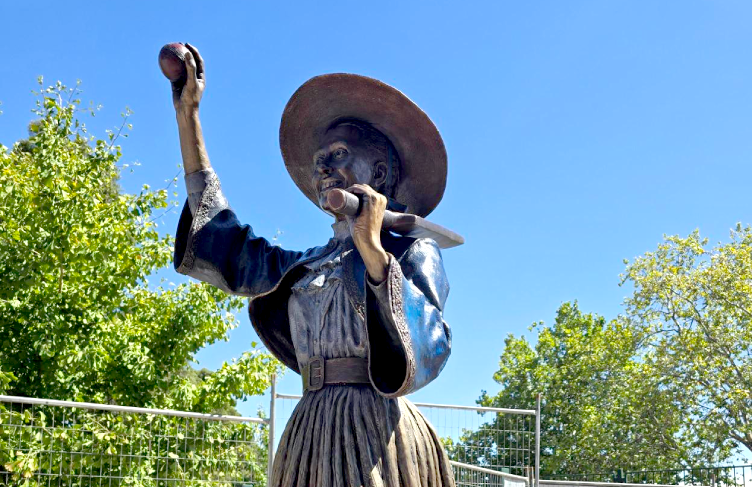
Barbara Rae celebrates the win is a 1.9 metre tall bronze sculpture that captures the joy of Barbara Rae, the top scorer and winning captain of Australia’s first women’s cricket match, played on 7 April, 1874.
It stands at the entrance to Queen Elizabeth Oval on View St in Bendigo, Dja Dja Wurrung country.
The sculpture was created by Lis Johnson at her studio in central Victoria and the bronze cast at Mal Wood Foundry in Reservoir. Barbara Rae stands tall on her plinth, bat and ball in hand, striding off the field victorious.
Lis Johnson is one of Australia’s most respected figurative portrait sculptors. Her work includes iconic Australian sporting heroes at the MCG and Rod Laver Arena and five political figures in Canberra’s Parliamentary Triangle.
Lis drew on historical images and research to create the sculpture - first a small-scale maquette, then the full-size version. A model wore a historically accurate dress with its tight corsetry and large bustle to pose for Lis with a cricket bat and ball.
Lis said: ‘I really enjoyed researching, designing and creating the Barbara Rae sculpture. It is lovely to work on a portrait figure that radiates joy.
‘I aimed to capture Barbara's youthful confidence and determination, and to faithfully sculpt her many layered period outfit.
‘While the sculpture portrays a specific young woman in a moment of free-spirited celebration, I think it also celebrates the achievements of all women who persist and achieve in spite of restrictive expectations.’
Barbara Rae (b. 1855 – d. 1891) was a primary school teacher. She helped organise the history-making match, recruited other women to play and arranged coaching sessions at the local cricket grounds.
Aged just 19, Barbara captained the winning Blues team and was judged to be the player of the match with a top score of 36 not out. Barbara’s stepmother, Emily Rae, captained the opposing Reds team.
Thousands of spectators gathered to watch the women and at first the match was deemed a success. But in the following days the players faced hostility in Victorian newspapers for what was considered ‘deplorable’ and ‘unseemly’ behaviour for the times.
One newspaper even labelled the 22 players ‘frisky matrons and forward spinsters’.